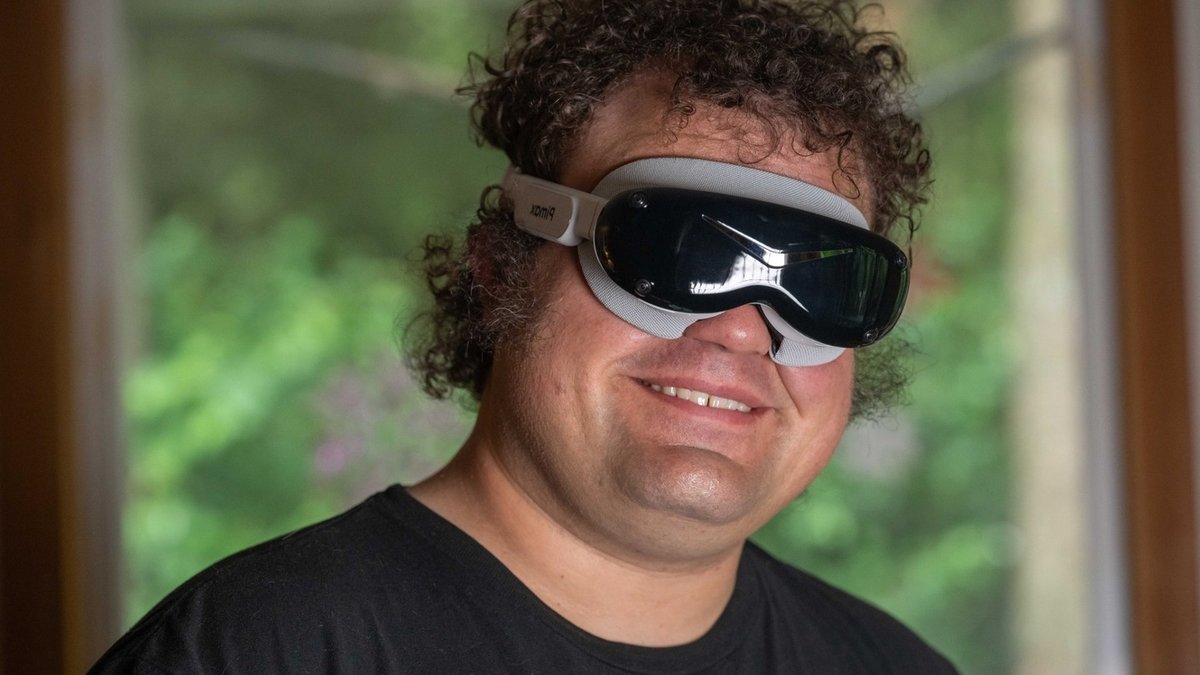
The Pimax Dream Air is marketed as the “world’s smallest full-feature 8K resolution VR headset,” offering a sleek alternative to the bulky headsets common in high-performance virtual reality. It resembles futuristic designs more than current hardware. Specifications include micro-OLED displays with 3840 x 3552 pixels per eye, a 102-degree field of view, and a 90Hz refresh rate. Additional features are foveated rendering, built-in audio, and black-and-white video passthrough. After a month of testing, the headset includes many features VR users want, though its $2,299 price for the SLAM version may deter some buyers.
Streamlined and Lightweight Design
The Dream Air differs from earlier VR headsets by being compact rather than large and angular. It fits even XXXL head sizes, though putting it on requires effort. The face liner is comfortable and removable with magnetic attachments. Controls for power and volume sit on the headset, but adjusting them leaves smudges on the glossy front. The built-in speakers deliver clear sound without leaking to others.
Expansive FOV and Excellent Picture Quality
Pancake lenses allow the Dream Air to achieve a 102-degree field of view, the widest available in a micro-OLED headset. High resolution and this wide view create immersion, especially in games like Star Wars: Squadrons and Half Life: Alyx. In Until You Fall, the display was sharp and vivid, pulling players into the experience.
The most notable drawback is the limited space for very large heads. The snug fit makes it difficult for users at the upper size range. Older hardware may also struggle with latency due to motherboard bandwidth, but modern systems handle it well.
Related: Hydrogen car smashes two speed records in a week
Controllers and Value
The included controllers are the same models Pimax has shipped for years. They are rechargeable with a practical layout but don’t match the premium feel of the headset. A separate version supports Lighthouse tracking for Valve’s knuckle controllers, though this requires buying base stations. The tested SLAM version avoids this need, simplifying setup.
At $2,299, the Dream Air costs more than alternatives like the Valve Index, which is sold out. The Bigscreen Beyond 2 starts at $1,019 but needs base stations. Pimax also offers the Dream Air SE for $899, though it lacks the flagship’s ultra-high resolution.
The headset excels in build quality, ease of use, and durability. Its lightweight design and high-end specs make it appealing to enthusiasts who can afford it and have compatible hardware. It is available from $1,999 on Pimax’s website.
For those tracking speed innovations, recent tests show hydrogen-powered vehicles breaking records in similar high-tech fields.
