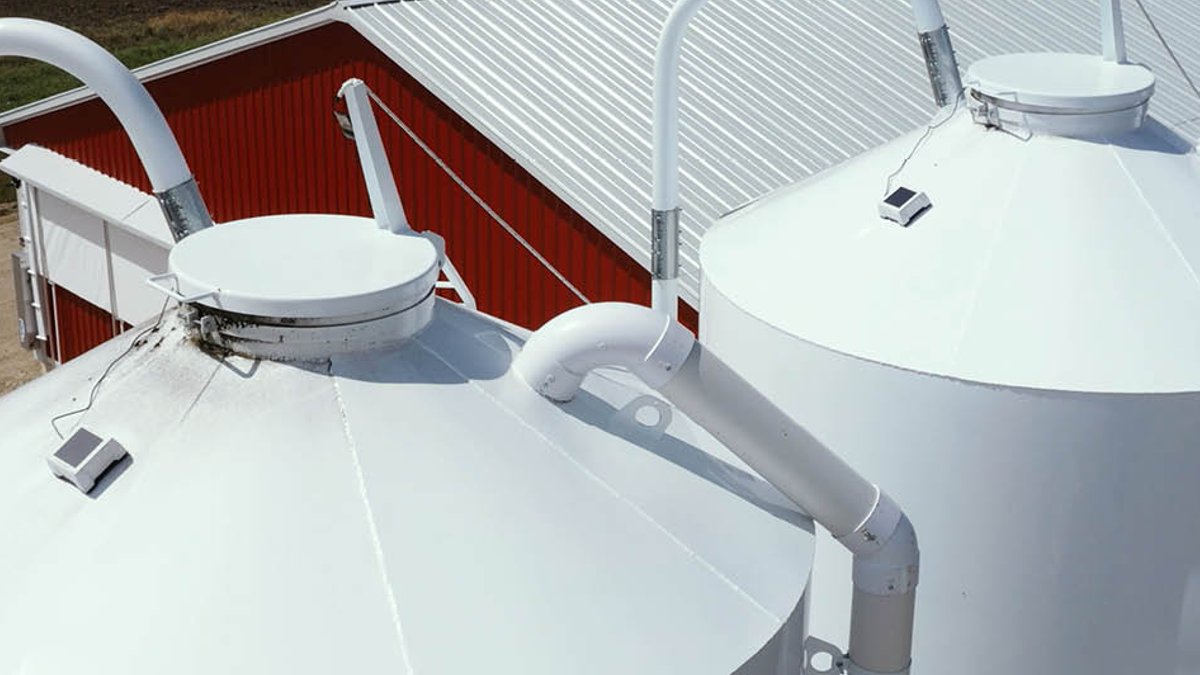
When Ben Allen joined BinSentry as CEO four years ago, the Kitchener, Ont.-based AgTech company was monitoring animal feed volume in roughly 4,500 bins. Today, the company is monitoring more than 65,000 feed bins in real time across North America and Brazil. Last year alone, the firm recorded 100 percent year-over-year growth with zero customer churn.
“When you’re a company that’s scaling as quickly as we are, you need to know that your partners can scale as well,” Allen said.
Allen credits that trajectory to a recipe he sees as valuable in agricultural technology and industrial AI: durable technology, an enterprise focus, and a balance sheet that proves ROI at scale. He believes those ingredients have helped make the business “one of the fastest growing AgTech companies on the planet.”
“When you can save big companies money, then you’ve got a chance at scaling your company,” he said. “You can instill confidence in large enterprises that not only can you show up, but that you can be a part of their success.”
How the technology actually works
BinSentry’s technology monitors animal feed levels in bins at barns that raise chickens, turkeys, pigs, and dairy cattle. Its sensors use AI-driven machine vision technology to create detailed, three-dimensional images of the surface from any angle inside a feed bin on the farm. The software feeds that real-time inventory data into an online dashboard.
“That demand signal of ‘how much feed do we need and where do we need it’ backs up and affects all of the milling schedules, it affects all the transportation and logistics, it affects the labour schedules in the mills,” Allen said. “When that data signal is bad, which it is when humans do it, then everything’s just messier.”
Feed represents roughly 65 percent of the cost of goods sold in raising an animal, which he said makes it the highest cost for protein producers. Across much of the industry, feed levels are still checked manually, often by climbing a ladder, looking into a dark bin, and estimating how much feed remains.
Related: Feds Seek Public Input on AI Transparency
BinSentry has conducted large-scale studies with swine producers, showing its monitoring technology can improve feed conversion ratios, which measure how efficiently livestock convert feed into desired outputs, by up to seven points. The CEO described this as a “step function change” for protein producers.
While many AgTech businesses have historically sold to farmers, the company built its model around large enterprise customers, where operational savings can be measured across industrial volumes. Although many startups aim to eventually serve large companies, Allen argued that the firm has the technology, service infrastructure, and balance sheet to actually do it.
“We can actually serve the big guys as opposed to running pilot R&D projects with them,” he said. “We can actually take their business at scale.”
Hardware gives it a defensible edge
Executing that approach successfully requires more than software. BinSentry describes itself as hardware-enabled and AI-native. Its sensors create an always-on data stream, which its software uses to support operational decision-making. Allen said combining the two is especially valuable in agriculture, where data has historically been difficult to capture accurately.
The firm was an early adopter of artificial intelligence. In 2023, it secured a patent for its method that uses AI to accurately determine animal feed volume.
“We’re very aggressive about the use of artificial intelligence,” he added. “We have a patent in it that’s multiple years old. We use it aggressively in our own coding, and we use it in our own tool sets, and we place it into the products that we sell.”
That early bet has already paid off.
Related: Lego Donkey Kong arcade machine delights Miyamoto
Allen said the company was one of the first AI investments made by the Business Development Bank of Canada’s Industrial Innovation Venture Fund in 2020.
The hardware side also gives the business a defensible position at a time when investors are questioning whether software alone remains a durable moat. He said hardware-enabled AI services are becoming one of the most attractive segments of the market because the physical installation creates a sticky, continuous data layer inside its customers’ operations.
But hardware also has to work in the real world, where animal feed moves by the ton, seven days a week, in heat, cold, and dust. “Ag is a really rough and tumble industry,” the CEO added.
Much of BinSentry’s engineering investment has gone into making its technology durable enough for that environment. The engineering work is led from Kitchener, where the team is approaching 40 people and adding an engineer every three weeks. It also has more than 60 service technicians across North America.
It’s possible that the hardest part of the firm’s model to copy isn’t the AI or the software, but the slow, expensive work of installing hardware on thousands of barns and keeping it running. Competitors could build similar algorithms, but matching a physical network that already covers that many bins on two continents takes years and significant capital — the kind of barrier that tends to keep copycats at bay.
Growth, partnerships, and what comes next
It’s an exciting time for the company, according to Allen. The business signed a distribution agreement with Cargill, one of the world’s largest food corporations, to begin operations in Brazil. It has also expanded its product line by launching ProSense HD sensors for milling environments. The company closed a $68.8-million CAD ($50-million USD) Series C financing round last year, as well as $34.5 million CAD ($25 million USD) in growth capital from CIBC Innovation Banking.
Allen said the firm was looking for a partner that could scale with it, support operations on both sides of the Canada-US border, and understand the complexity of a business that combines hardware, AI, enterprise software, and physical service. He said they found that partner.
Related: Canadian duo creates AI for top jobs
“Our commitment is long-term,” said Ab Makalo, Director at CIBC Innovation Banking. “We support companies from early stage through growth, pre-IPO, and beyond. The goal is that you can never outgrow what we can offer.”
Makalo said the company reflects the qualities the bank looks for in the AgTech sector right now: an embeddable product, a large market opportunity, and an ability to move into the core operations of large customers.
“What’s shifted in Agtech recently is that platforms combining hardware, software, and analytics are now delivering near-term, measurable ROI, and that changes how operators think about the spend,” he added. “It stops being discretionary.”
BinSentry is continuing to expand its engineering team, grow its service footprint, and evaluate new markets and products. Allen said the company is still investing in the same ingredients that drove its growth up to this point.
He believes that the company’s trajectory also carries a lesson for other Canadian AgTech businesses. The firm’s roots remain in Canada, but the US now accounts for the majority of its revenue.
“If you’re a Canadian tech company, you have to start thinking early on about what it means to chase other markets and expand your reach,” Allen said. “If you’re going to scale, then you need North America, not a country.”
Execution of that vision is expensive, he said, which made finding the right support even more critical.
